


Vietnam coffee sector battles through highs and lows in 2023
Global coffee prices increased in 2023, but traders and exporters endured a stressful year, and international buyers now recognize that Vietnamese robusta supplies are no longer limitless, writes Phan Minh Thong, general director of Phuc Sinh Group, a leading coffee exporter in Vietnam.
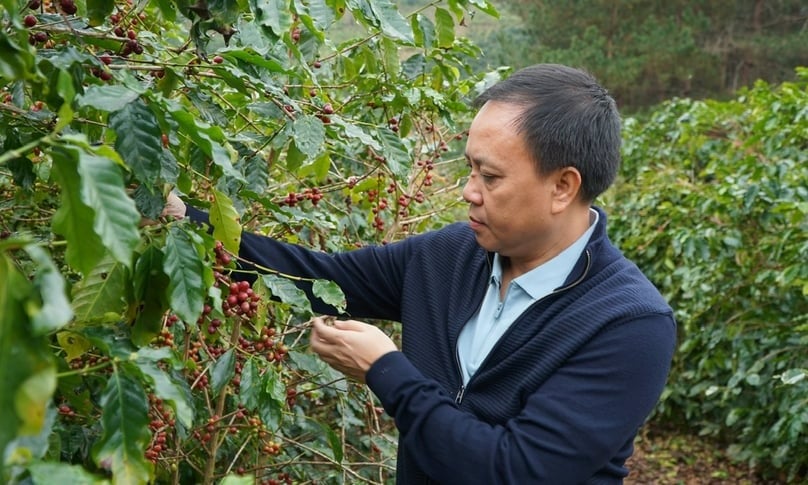
Phan Minh Thong, general director of Phuc Sinh Group. Photo courtesy of Phuc Sinh.
Coffee prices began to rise at the start of 2023. After years of stasis at $1,200-1,400 per ton, global coffee prices have risen to $1,900-2,000 per ton. Everyone was happy, especially farmers.
From the magic number of VND34,000 ($1.39) per kilogram of raw coffee, prices rose to VND42,000 ($1.72) and then VND44,000 ($1.8) per kg. Supply was abundant, but businesses were concerned about the affortability.
Vietnam has long been the world's leading producer and supplier of robusta coffee, and the rest of the world has become accustomed to purchasing Vietnamese robusta at low prices. Roasters throughout the world had updated their recipes, with Vietnamese robusta being the most common ingredient. Famous European and American brands were selling coffee at good to very good prices, with low input costs for Robusta from Vietnam.
Coffee purchasers around the world were overjoyed because the supply of Vietnamese coffee was abundant and cheap, and many believed supplies would never run out.
After Lunar New Year 2023, supply remained robust, and coffee prices fluctuated from VND42,000 ($1.72) per kg to VND48,000 (1.97). For the first time in 15 years, coffee costs had risen to a new high. Farmers and small suppliers sold large amounts, and when the price reached VND50,000 ($2.05) per kilogram, practically all farmers had sold out. Traders and small suppliers also emptied their warehouses.
Everyone in the coffee industry saw it as a fantastic price and assumed that it couldn't go any higher. The quantity of sales was enormous, and coffee dealers from warehouses, small suppliers, and large exporters assumed supplies would last.
At a price of VND50,000 ($2.05) per kg, many large companies did not want to buy because they thought it was too expensive compared to previous years, so they bought in moderation.
Not only did large coffee importers believe this, large traders and the majority of Vietnamese exporters believed coffee was still available, however, in May 2023, coffee supplies became very scarce. Buying coffee was far more challenging, but neither exporters nor roasters expected that Vietnam would experience a coffee shortage in 2023.
This was understandable because for decades, when farmers or suppliers in raw material areas said there was a crop failure, the export output did not change much, and they could always buy coffee. If farmers didn't sell, they only had to wait two or three days to buy coffee again. If traders can't buy that price, they can just pay VND200,000 ($8.19) per ton more to buy. Vietnam produces 1.7–1.8 million tons of coffee each year.
However, in 2023, coffee costs rose, beginning in mid-May. Supply was no longer ample, but monthly export contracts remained as plentiful as ever.
In June 2023, buyers began to put pressure on exporters, and the entire market was surprised: Vietnam had run out.
With decades of experience in the coffee industry, we had seen that when coffee ran out, exporters normally had to wait a few days or a week to get more, but this did not happen in 2023.
For the first time in the 25-30 years, numerous surveys of coffee raw material areas were done. The coffee warehouses were nearly empty, with only a few bags, and there were so many questions about why this happened.
International buyers became concerned when commitments to deliver coffee went unfulfilled because very few batches of coffee were supplied. They became impatient. They applied pressure on exporters and organized visits. They visited the representative offices of foreign coffee firms in Vietnam first, then warehouses in raw material areas before going to export companies' offices to seek answers. However, they simply received the response that exporters would attempt to purchase and deliver.
In fact, the buying volume was relatively low, and exporters could not supply much. So it was the overseas parent company's time to exert pressure on the Vietnamese office. Then, roasters and buyers from abroad requested deliveries, but the situation was not good because Vietnam had ran out of coffee.
For the first time in more than 20 years in the profession, we saw purchasing managers, traders, and coffee brokers exhausted. They were under pressure from their bosses as well as buyers with whom they had contracts.
Exporters were also struggling since there was no coffee to buy, resulting in no goods to deliver. Following that, coffee-buying firms began demanding reimbursement from exporters, and they continued to apply pressure. From July to October 2023, exporters faced intense pressure from both buyers and suppliers. Everyone was reeling because they were unable to function without coffee.
International buyers who had previously been familiar with Vietnam's unlimited supply of robusta came to the country to survey and were surprised to find empty coffee warehouses everywhere.
To explain the lack of coffee, we must first realize that Vietnam has grown quickly over the last decade, with real estate being one of the most developed sectors. Land prices have ranged from VND200-300 million ($8,200-12,295) per hecta during the last 10 years, but are now at $2-3 billion ($81,967–122,950) per hecta.
Every year, coffee farmers sell a little bit of land, which adds up over 10 years, causing the coffee growing area to drop dramatically. After the Covid-19 epidemic, fewer people worked in agriculture, labor expenses rose, and variable weather conditions cause significant agricultural changes. These three variables led to a major decline in coffee output.
In January 2024, the coffee business saw several unforeseen developments. When surveyed, everyone believed that this year's 2023-2024 crop was strong and began selling hundreds of thousands of tons in advance. Farmers and suppliers in raw material locations supplied coffee in huge numbers for VND50,000 ($2.05) per kilogram, after which the price rose to VND52,000 ($2.13) per kilogram and VND54,000 ($2.21) per kilogram.
Farmers refused to supply goods to dealers they had deals with as coffee prices continued to rise. Traders who had not delivered goods continued to disrupt warehouses and exporters, throwing the coffee sector into disarray. In the Central Highlands, many coffee businesses went bankrupt. The situation disrupted the coffee industry's decades-long business model. Many coffee supply companies in raw material areas will continue to fail, prompting exporters to confront numerous challenges and declare bankruptcy.
Besides, if coffee prices rise, smaller roasters will suffer. The coffee roasting industry is likewise intensely competitive, with many small and medium-sized roasters forced to sell inexpensively in order to get access to supermarkets and retail networks. Input costs are rising, but selling prices remain unchanged, signaling the demise of the small and medium roasting business, which had relied on inexpensive Vietnamese robusta coffee for many years.
There are also claims that farmers are greedy. Coffee costs VND78,000 ($3.2) per kilogram, yet they still refuse to sell it. It should be noted that everyone is greedy, not just farmers. For decades, they have marketed it inexpensively, and we believe it comes naturally. However, we came to learn that nothing lasts forever. Farmers have reasons for doing this, and we must acknowledge the situation in order to adapt our business plan.
However, looking back over the coffee industry's 20-year history, we can see that large coffee roasting and distribution corporations around the world have taken advantage of cheap Vietnamese coffee to make huge profits. After decades of tremendous profits, they have compelled their vendors, from exporters to merchants, to pay late, ranging from 150 to 360 days. It seems funny, but it's completely accurate.
When drafting contracts, they require exporters and traders to pay interest for 150 to 360 days of late payments. Multinational corporations obtain significant tax breaks and now force homeowners to pay half a year to a year late. The same is true for large customers in the spice market, including pepper. They are already wealthy, but with this business model, they will become even wealthier!
The same goes for delivery. When the harvest is plentiful and customer demand is low, large corporations are willing to force exporters to deliver 3-12 months late, even if exporters have purchased full warehouses. If exporters continue to deliver, they will not be compensated, and it is difficult to claim that their warehouses are full when their customers are spending less. However, when the contrary occurs and they require supplies, they push us really hard.
Doing business is already challenging, and it is becoming increasingly difficult. Export enterprises have no choice but to accept this without recompense.
However, life has always had its own reasons. After 2023, consumers will recognize that Vietnamese robusta is no longer limitless, and they must pay close attention to Vietnam's market. And the answer is that for the coffee industry's long-term sustainability, both buyers and sellers must show respect for coffee, coffee growers, and growing areas. To develop this industry responsibly, large coffee firms around the world should be less greedy and collaborate with exporters and coffee farmers.
- Related News


- Read More

HCMC real estate gains appeal as International Financial Center to take shape
With the establishment of an International Financial Center, Ho Chi Minh City will form an elite community of entrepreneurs and professionals from around the globe. This is very attractive for real estate investors, says architect Truong Van Quang, deputy secretary general of the Vietnam Urban Planning and Development Association (VUPDA).
Real Estate - Mon, December 29, 2025 | 8:00 am GMT+7

Taseco Group marks 20th anniversary, receives Second Class Labor Medal
Taseco Group in December 20 celebrated its 20th anniversary and received the Second Class Labor Medal – a prestigious award from the Party and State recognizing the company's outstanding contributions to socio-economic development.
Companies - Sun, December 28, 2025 | 12:55 pm GMT+7

Top 10 standout international events in 2025
The U.S.'s imposition of reciprocal tariffs, the Thailand-Cambodia border conflict, and the AI race are among the 10 prominent international events in 2025 as selected by Vietnam News Agency.
Politics - Sun, December 28, 2025 | 12:40 pm GMT+7

Vietnam’s jewelry major PNJ to pay cash dividend, seek share bonus as stock defies market slump
Phu Nhuan Jewelry JSC (HoSE: PNJ) said it will pay an interim cash dividend for 2025 at a rate of 10% and seek shareholder approval to issue bonus shares in January next year. Its stock has risen against a broader market correction.
Companies - Sun, December 28, 2025 | 11:12 am GMT+7

HCMC to launch Free Trade Zone linked to Cai Mep Ha Port
Ho Chi Minh City plans to establish a free trade zone (FTZ) linked to Cai Mep Ha Port, with future expansions to Can Gio, An Binh and Bau Bang, optimizing unique local advantages while maintaining a unified management model, according to a new resolution.
Infrastructure - Sun, December 28, 2025 | 8:00 am GMT+7

Vingroup's hospitality arm appoints new CEO
Vinpearl Joint Stock Company, a leading investor and operator of resorts and theme parks in Vietnam, has appointed Ngo Thi Huong as its new CEO, starting from Friday.
Companies - Sat, December 27, 2025 | 9:02 pm GMT+7

Advisory council recommends Vietnamese government not expand monetary policy in 2026, exercise more caution
Vietnam’s National Financial and Monetary Policy Advisory Council has recommended that the Government refrain from expanding monetary policy in 2026, adopt a more cautious approach, and coordinate monetary and fiscal policies in a balanced manner.
Consulting - Sat, December 27, 2025 | 4:01 pm GMT+7

Nguyen Thanh Phuong exits BVBank board, leads strategy board
Nguyen Thanh Phuong will step down from the board of directors at Vietnam’s private lender BVBank (BVB) for the 2025-2030 term, as decided at an extraordinary shareholders’ meeting on Friday.
Banking - Sat, December 27, 2025 | 12:03 pm GMT+7

PV Gas plans over $3.8 bln investment for 2026-2030, eyes LNG infrastructure, M&A as priorities
PV Gas, the investor of Thi Vai LNG terminal in Ho Chi Minh City, plans to invest more than VND100 trillion ($3.8 billion) in the 2026-2030 period, with LNG infrastructure and mergers and acquisitions (M&A) among its strategic priorities, said parent company Petrovietnam.
Industries - Sat, December 27, 2025 | 10:32 am GMT+7

HCMC proposes adding 5 metro lines connecting Long Thanh airport, Binh Duong, Vung Tau
The Ho Chi Minh City People’s Committee has proposed adding five metro lines to the appendix of the parliamentary Resolution No. 188 on piloting special mechanisms and policies to develop the urban railway network in Hanoi and HCMC.
Infrastructure - Sat, December 27, 2025 | 8:00 am GMT+7

Thaco enlarges charter capital by one-third ahead of Vingroup’s exit from high-speed rail bid
Vietnamese conglomerate Thaco Group has increased its charter capital by a third, just one day before rival Vingroup announced its withdrawal from the planned North-South high-speed railway project.
Companies - Fri, December 26, 2025 | 5:11 pm GMT+7

Le Ngoc Son appointed as Petrovietnam chairman
Petrovietnam's (PVN) CEO Le Ngoc Son has been appointed chairman of the state-owned group's members’ council.
Companies - Fri, December 26, 2025 | 4:54 pm GMT+7

Vietnamese fast food consumers spend average $5.5 per visit, chicken meals dominate
Vietnamese consumers are spending an average of VND144,500 ($5.5) per receipt at major fast-food chains, according to a December report by market research firm Q&Me.
Society - Fri, December 26, 2025 | 2:53 pm GMT+7

The aviation ecosystem game: Can Sun Group win?
Phu Quoc holds a rare advantage in having established a relatively comprehensive aviation ecosystem, comprising the expanded Phu Quoc International Airport and an airline bearing the island’s name – Sun PhuQuoc Airways.
Companies - Fri, December 26, 2025 | 2:44 pm GMT+7

Vingroup units, Idico sign strategic deal on clean energy, green transport
Four arms of Vingroup (HoSE: VIC) on Thursday signed a strategic cooperation agreement with major industrial park developer Idico, targeting clean energy supply and electrification of transport across the latter’s industrial zones.
Companies - Fri, December 26, 2025 | 2:19 pm GMT+7

Fueling Vietnam’s growth
Vietnam is heavily investing in large-scale, long-term projects in energy and infrastructure sectors which require billions of dollars far more than can be easily raised through internal business profits or tight domestic loans, writes Tim Evans, CEO, HSBC Vietnam.
Economy - Fri, December 26, 2025 | 1:38 pm GMT+7