


Vietnam infrastructure spending surges 40%
Vietnam’s infrastructure spending surged 40% year-on-year in the first half of the year, fuelled by fast-tracked approvals of projects amid provincial mergers; legal reforms granting provinces more decision-making authority over project approvals; and the streamlining of disbursement processes, write chief economist Michael Kokalari and senior analyst Thai Viet Trinh at VinaCapital.
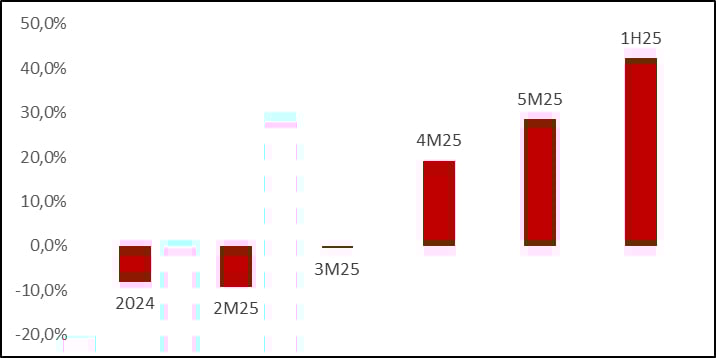
Surging infrastructure disbursement in H1/2025. Source: Ministry of Finance, VinaCapital.
Vietnam is embarking on sweeping reforms across both the public and private sectors that some are calling “Doi moi 2.0.” (Reform 2.0).
These initiatives aim to boost the country’s GDP growth potential by increasing the (already highly significant) role of the private sector in the economy, streamlining the Government’s own operations, and addressing other sources of inefficiency in the economy.
The first signs that these reforms are working are already emerging: there has been an impressive 40% surge in infrastructure spending in H1, according to the Ministry of Finance, which in turn reflects progress on streamlining the approval processes that impeded spending in recent years.
Vietnam’s infrastructure spending actually declined in 2024, as can be seen in the chart below, despite a dire need for increased investment in this rapidly industrializing country. The Q2 spending rise that can also be seen below was driven both by a heightened sense of urgency across Government agencies and newly expanded authority for local governments to fast-track and execute major projects.
Specifically, spending is increasing at the local level, where disbursement is up by more than 40% year-on-year. Several provinces in Vietnam are undergoing mergers as part of the broader, sweeping reforms across both the public sector and the private sector.
Provincial mergers, plus other internal Government initiatives, have promoted a sense of urgency among both local and central Government officials, which is one factor prompting local authorities to fast-track project approvals – especially those that are “shovel ready,” such as expanding existing roads/highways.
In addition to increased urgency, recent legal reforms are essentially delegating a lot more authority in public projects to the local level. The National Assembly recently approved a series of measures that enable local authorities to approve major projects (e.g., airports and urban area developments larger than 50 ha) that previously required Prime Minister-level approval.
In addition, the approvals process for local and national public projects is being streamlined and the Government is actively encouraging more Public-Private Partnerships (PPP), including both a resumption of build-transfer (BT) projects, which had been stalled for the last few years, and a potential widening of the definition of PPP projects to well beyond roads, bridges, and tunnels to potentially include data centers and other components of “high tech infrastructure.”
For example, the merger of 63 province-level treasury offices into 20 regional offices cut the number of required interactions between contractors and state treasuries by about half and contractors are now able to submit documents online to regional State Treasury offices. The net result is a dramatic drop in the time it takes for financial disbursements to reach contractors – to just 1-3 days – much faster than the previous process, which required multiple in-person interactions and an abundant amount of manual paperwork.
In short, the confluence of provincial mergers, regulatory relaxation, and an overall heighted focus on economic growth in the Government is helping to drive this increase in infrastructure spending, which is seen as a key driver of GDP growth.
Finally, progress on larger scale national projects is also accelerating, and the completion timelines on several major projects such as the $13 billion Long Thanh International Airport, $13 billion Hanoi and HCMC ring roads, and $8.4 billion Lao Cai-Hanoi-Haiphong railway has been shortened by as much as three years.
Legal framework updates
Vietnam’s Government is working on modifying several laws related to infrastructure investments with the aim of increasing private sector involvement in projects that are aligned with national infrastructure objectives and to further streamline the disbursement of public funds. Some key legal developments are listed in the table below.
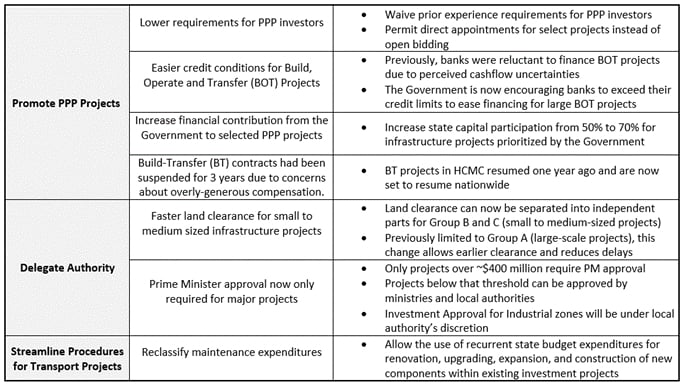
Vietnam is well-positioned to sustain its strong momentum in disbursements of infrastructure investments; Government debt is below 40% of GDP, the budget surplus was over 5%/GDP in the first five months of 2025, and it has over $45 billion in undisbursed funds earmarked for infrastructure spending. The primary impediment to faster infrastructure disbursement in the past has been legal and regulatory bottlenecks, which the measures listed above will help alleviate.
Beneficiaries of infrastructure spending
Despite higher infrastructure investment in Vietnam, investment options in listed infrastructure-related stocks in Vietnam remain somewhat limited, although some “second derivative” stock plays such as construction materials firms can give investors good indirect exposure to the nascent boom.
Many of the key contractors and materials suppliers that are benefiting from increased infrastructure investments in Vietnam are private firms, such as Son Hai and Truong Son; some of the publicly listed infrastructure firms suffer from unsophisticated corporate governance or financial management.
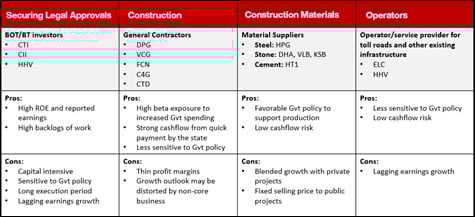
That said, certain firms like Vietnam’s leading steel producer Hoa Phat Group (HPG) have good corporate governance, stronger management teams, and healthier cash flows. HPG has substantial production capacity, its growth is closely linked to Vietnam's infrastructure development, and the company is expanding its capabilities into producing the steel required to build high-speed railway rails, given the Vietnamese Government’s Resolution 172. The table below highlights various listed infrastructure companies categorized by the sub-segments of infrastructure development that they specialize in.
Conclusion
Vietnam’s infrastructure spending surged 40% year-on-year in H1/2025 fuelled by: 1) fast-tracked approvals of projects amid provincial mergers; 2) legal reforms granting provinces more decision-making authority over project approvals; and 3) the streamlining of disbursement processes.
Going forward, the Government is revamping many investment laws to boost private investment, relaxing PPP and BOT conditions, increasing state contributions and expanding eligible project types.
- Related News


- Read More

VN-Index approaches 1,800-point mark as easing Middle East tensions lift sentiment
Vietnam's benchmark VN-Index edged closer to the 1,800-point threshold on Monday as improving sentiment over easing tensions in the Middle East boosted risk appetite, driving gains in brokerage stocks while oil and Vingroup-related stocks weighed on the market.
Finance - Mon, June 15, 2026 | 8:34 pm GMT+7

Japanese products dominate Vietnamese consumer trust, but younger shoppers rewriting rules
Japanese products continue to enjoy the highest level of trust among Vietnamese consumers, reinforcing the country’s position as the benchmark for quality and reliability in one of Southeast Asia’s fastest-growing consumer markets, according to a new survey by market research firm Q&Me.
Economy - Mon, June 15, 2026 | 6:48 pm GMT+7

VinEnergo ramps up renewable energy push with 4 new subsidiaries
VinEnergo, the energy arm of Vietnamese conglomerate Vingroup, has accelerated its expansion into the power sector, establishing four new subsidiaries within a week as it builds a growing portfolio of renewable energy and infrastructure projects across Vietnam.
Companies - Mon, June 15, 2026 | 4:52 pm GMT+7

Thaco deepens ties with Hyundai Rotem to localize railway manufacturing in Vietnam
Vietnamese conglomerate Thaco and South Korea’s Hyundai Rotem have signed a detailed technology transfer and localization agreement for railway rolling stock production.
Industries - Mon, June 15, 2026 | 4:01 pm GMT+7

UOB Vietnam appoints Pham Hong Hai as deputy country CEO
Singapore's United Overseas Bank (Vietnam) Limited on Monday appointed Pham Hong Hai, former CEO of HSBC Vietnam and later Vietnamese bank OCB, as deputy country CEO, effective immediately.
Banking - Mon, June 15, 2026 | 2:26 pm GMT+7

Shinhan Bank Vietnam launches AI translation desk, strengthening customer experience, digital innovation
Shinhan Bank Vietnam has officially launched AI Translation Desk, an AI-powered interpretation solution designed to help foreign customers communicate more easily while using banking services in Vietnam.
Banking - Mon, June 15, 2026 | 12:03 pm GMT+7

FDI listings a missing piece in Vietnam's stock market development
As Vietnam's stock market moves closer to its long-awaited upgrade to secondary emerging market status and seeks to attract higher-quality capital, allowing more foreign-invested companies to list on domestic exchanges could broaden the pool of investable assets and support the next phase of capital market development.
Finance - Mon, June 15, 2026 | 11:14 am GMT+7

Chinese robot 'eyes' manufacturer builds 10-hectare factory in northern Vietnam
Orbbec Inc., a Chinese company specializing in 3D vision sensors and robotic hardware, is building an over-10-hectare manufacturing center in the northern province of Bac Ninh to serve international markets.
Industries - Mon, June 15, 2026 | 8:00 am GMT+7

Long Thanh airport project faces shortage of 2,000 workers
The Long Thanh International Airport project in the southern province of Dong Nai is still short nearly 2,000 workers compared to actual requirements during its final acceleration phase.
Infrastructure - Sun, June 14, 2026 | 6:08 pm GMT+7

Nghi Son Refinery and Petrochemical Complex turns profitable in Q1 on full-capacity operations
Operating at full capacity, the Nghi Son Refinery and Petrochemical Complex in Vietnam's central province of Thanh Hoa reported its first profit in Q1/2026, marking a significant turnaround after years of losses.
Economy - Sun, June 14, 2026 | 2:45 pm GMT+7

50 years of Gamuda Berhad and its urban development journey in Vietnam
Celebrating 50 years of establishment and growth, Gamuda Berhad – one of Malaysia’s leading infrastructure and urban development groups – has evolved from an infrastructure specialist into an integrated urban developer with a growing presence across Asia.
Real Estate - Sun, June 14, 2026 | 11:21 am GMT+7

Industrials, technology top Vietnamese sectors in M&A transaction volume
Vietnam’s M&A market recorded 24 transactions in May, with industrials, technology and healthcare sectors being the most active sectors in terms of transaction volume, writes Grant Thornton analysts.
Consulting - Sun, June 14, 2026 | 9:00 am GMT+7

Top Vietnamese garment maker Vinatex's H1 profit rises 14%, weak order visibility clouds outlook
Vietnam National Textile and Garment Group (UPCoM: VGT) reported consolidated profit growth of 14.4% in the first half of 2026, driven by a strong recovery in its yarn business, even as weakening global demand and uncertainty over U.S. trade policy cast a shadow over the sector’s outlook.
Companies - Sun, June 14, 2026 | 8:00 am GMT+7

Gamuda Land Vietnam recognized among Top 10 Enterprises Pioneering Green Transformation 2025-2026
Gamuda Land Vietnam has been recognized as one of the “Top 10 Enterprises Pioneering Green Transformation 2025-2026” at the 25th Golden Dragon Awards.
Companies - Sat, June 13, 2026 | 7:45 pm GMT+7

T&T pushes ahead with $97 mln industrial park project, eyes new urban area projects in northern Vietnam
Vietnamese conglomerate T&T Group is seeking to accelerate five projects in Bac Ninh while proposing two new developments in this northern province.
Infrastructure - Sat, June 13, 2026 | 7:09 pm GMT+7

VinFast guns for 300,000 EV deliveries in 2026, spins off manufacturing operations
VinFast, the EV arm of Vietnamese conglomerate Vingroup (HoSE: VIC) targets at least 300,000 electric vehicle deliveries globally this year, up 52% year-on-year, while pursuing a restructuring plan aimed at improving capital efficiency, according to a report by Vietcap Securities.
Companies - Sat, June 13, 2026 | 3:07 pm GMT+7
- Travel
-

Sun PhuQuoc Airways launches Singapore route, connecting two of Asia's 'paradise' islands
-
Seta - A “silken thread” weaving contemporary Cantonese cuisine into the soul of Phu Quoc
-
Danang airport starts $57 mln terminal expansion
-
Asia’s leading luxury travel magazine hails Hanoi's new opera house: 'Move aside, Sydney'
-
Work on $92 mln eco-urban resort project starts in northern Vietnam tourist hotspot
-
Royal Shore Beachclub announces grand opening in Hoi An