


Diversifying export markets ‘golden key’ for Vietnamese firms: CEO
Expanding into alternative export markets such as India and the Middle East could prove a “golden key” for Vietnamese businesses, as demand in these regions remains strong and entry requirements are less stringent than in the U.S., according to Nguyen Tuan Viet, CEO of Vietgo, an im-export consultancy company.

CEO Nguyen Tuan Viet of im-export consultancy firm Vietgo. Photo by The Investor/Thang Quang.
The U.S. Department of Commerce’s (DOC) announcement of its preliminary conclusion on the imposition of anti-dumping duties of nearly 195% on Vietnamese plywood is causing significant concern. How do you assess the actual level of risk in the U.S. market for Vietnamese wood exporters in the 2026-2027 period?
The DOC has announced its preliminary conclusion on the imposition of anti-dumping duties of nearly 195% on Vietnamese plywood. If countervailing duties are added, the total tariff could exceed 200%.
In my view, this is not good news. In today’s plywood market, the U.S. is a key destination and a major market that any plywood exporter wants to enter and develop. Once this information is released, it will certainly have certain “unfortunate” impacts on the market.
However, from my perspective, the situation is not overly severe. There is still considerable space, opportunities and alternative angles that plywood enterprises can take advantage of.
What are the trends in U.S. import demand for products like plywood? Will trade defense measures change the “taste” of importers?
Looking broader, we can see a more positive outlook. Although there are no precise figures on the proportion of plywood exports to the U.S., our data shows that from 2020-2021 to the end of 2024, Vietnam experienced very strong growth in plywood and veneer exports, especially to India, Pakistan and the Middle East. This period saw excellent export performance for these products.
In India alone, with a population of 1.4 billion - nearly 20% of the world’s population, buyers are returning strongly to source goods from Vietnam. Of course, there are the Bureau of Indian Standards (BIS) standards, but with this trend, by mid-2026 (around July or August), the Indian market is expected to consume very large volumes. This is a key factor that helps maintain a positive export outlook for Vietnam’s wood industry, even when facing challenges in the U.S. market.
Not only the wood sector, but products such as steel (especially of companies like Hoa Phat Group), shrimp, and solar panels are also under investigation. In your opinion, are these isolated cases or part of a broader tightening trend by the U.S. toward Vietnamese goods?
We must recognize that the root of the issue lies in the U.S. aiming to control sources of production inputs. It sees that Vietnamese plywood may use raw materials imported from China, so countries like Vietnam, China, and Indonesia are being placed under scrutiny.
I believe this is part of a broader tightening across multiple product categories. These goods (steel, solar panels, plywood) have production origins closely linked to China (influenced by the U.S.-China trade war), making it easier for goods to transit through Vietnam than directly from Chinese ports such as Tianjin or Shanghai. Therefore, businesses need to proactively shift toward regions and markets that are not suspected of having Chinese-origin materials.
Facing the risk of high anti-dumping and countervailing duties (potentially exceeding 200%), which strategy should Vietnamese businesses prioritize: market diversification, pricing adjustments, or supply chain restructuring to minimize legal risks?
In the face of anti-dumping risks, Vietnamese enterprises should prioritize market diversification. In reality, U.S. trade defense measures are not new and have been applied frequently in recent years, so this should not come as a surprise.
The key products affected this time, such as steel and plywood, belong to reconstruction-related sectors. In the Middle East, reconstruction demand after conflicts is extremely high, leading to strong demand for materials like steel, copper, aluminum, plywood, and roofing sheets. This is a highly attractive market because it relies almost entirely on imports and does not impose overly strict standards.
Meanwhile, the Indian market is also seeing remarkable growth. In terms of order volume, under normal conditions, we receive around 50-70 plywood orders per month, but during peak periods, this can increase four to five times, reaching 200-300 orders.
Regarding technical barriers, although BIS standards apply, about 5-6 Vietnamese companies have already obtained certification, enabling deeper market penetration in India.
Even without U.S. tariff pressure, shifting toward the 460-million-strong Middle East and India, with over 1.4 billion people, would still bring substantial benefits to the plywood and veneer industry. With a combined market size of nearly 2 billion people and geographic proximity to Vietnam, this flexible market structure enables businesses to proactively expand and sustain strong growth.
From a long-term perspective, what recommendations would you give Vietnamese exporters, particularly in the wood sector, to avoid being caught off guard in the market?
In the long run, businesses need to proactively analyze and thoroughly verify the origin of their goods. U.S. tariffs are largely based on origin. If we can demonstrate that products do not pass through China, the U.S. may eventually adjust tariffs to more reasonable levels.
Plywood consists of two main components: veneer and adhesive. Since 2023, the Vietnamese government has taken strong measures to control origins. Businesses must handle this aspect meticulously to ensure transparency.
As for adhesives, simpler types (such as E2 glue) can be produced domestically, while adhesives exported to the U.S. (typically meeting E0 standards) must be imported. Therefore, clear origin documentation is needed to avoid unfair tariffs.
The government has been doing well in this regard, and further efforts should be made to enhance transparency. With that, I believe the U.S. Department of Commerce will reconsider the tariff levels.
Additionally, expanding into markets such as India and the Middle East remains a “golden key,” as import demand there is high and requirements are less stringent than in the U.S.
According to U.S. International Trade Commission (ITC) data cited by the U.S. Coalition for Fair Trade in Hardwood Plywood, Vietnam exported $401 million, $186 million, and $244 million worth of plywood and decorative wood products to the U.S. in 2022, 2023, and 2024, respectively.
- Related News


- Read More

From Phu Quoc to Sa Pa: Why Vietnam’s tourism accelerating in Southeast Asia
Leading U.S. business magazine Fortune has described Vietnam as an emerging tourism “hot spot” in Southeast Asia, driven by the strong rise of destinations such as Phu Quoc and Sa Pa.
Travel - Thu, July 9, 2026 | 11:09 pm GMT+7
VietinBank seeks to divest entire stake in Hai Phong Port via public auction
VietinBank (HoSE: CTG) plans to divest its entire stake in state-controlled Hai Phong Port (UPCoM: PHP) through a public auction on the Hanoi Stock Exchange (HNX), potentially raising nearly VND278 billion ($10.57 million).
Companies - Thu, July 9, 2026 | 5:10 pm GMT+7

Starlink begins taking orders in Vietnam, first-year service costs $1,190
Starlink, the satellite internet service operated by Elon Musk’s SpaceX, has released pricing and started accepting orders in Vietnam, with first-year costs estimated at about VND31.4 million ($1,190).
Companies - Thu, July 9, 2026 | 4:09 pm GMT+7
Masan High-Tech Materials partners with S Korea’s GBI on tungsten processing
Masan High-Tech Materials (UPCoM: MSR), the mining unit of Vietnamese conglomerate Masan Group (HoSE: MSN), has entered into a strategic partnership with South Korea’s GB Innovation (GBI) to process Korean tungsten concentrate into higher-value products in Vietnam, strengthening a non-Chinese tungsten supply chain.
Companies - Thu, July 9, 2026 | 3:51 pm GMT+7

Idemitsu Kosan expands energy ecosystem in Vietnam
After more than three decades of operations in Vietnam, Japan’s Idemitsu Kosan is further expanding its energy ecosystem with a biomass pellet plant project in the central province of Gia Lai.
Industries - Thu, July 9, 2026 | 1:43 pm GMT+7

Two banks to list on Ho Chi Minh City bourse, expand charter capital
Vietnam's private banks Vietbank and BVBank are finalizing the last steps to transfer their trading from the unlisted public company market UPCoM to the Ho Chi Minh Stock Exchange (HoSE), while simultaneously implementing plans to increase their charter capital.
Banking - Thu, July 9, 2026 | 11:51 am GMT+7

Strong Q2 earnings, lower interest rates to bolster Vietnam stocks
Strong second-quarter corporate earnings and declining interest rates are expected to support Vietnam's stock market in the coming months, brokerage firms said, as the market moves beyond a period of limited news flow and enters a more favorable phase driven by improving fundamentals.
Finance - Thu, July 9, 2026 | 8:00 am GMT+7
Wistron raises construction, equipment investment in northern Vietnam province to $178 mln
Taiwanese technology firm Wistron has increased its investment in factory construction and equipment in Ninh Binh province to $178.27 million, adding $24.5 million to expand its facilities at Kim Bang Industrial Park.
Industries - Wed, July 8, 2026 | 7:56 pm GMT+7

Sun Group targets groundbreaking for $624 mln urban projects in central Vietnam this year
Vietnam's leading developer Sun Group aims to begin construction of two urban projects worth a combined VND16.4 trillion ($623.78 million) in the central province of Quang Ngai by the end of 2026, while also advancing plans for a new expressway linking the province with the Central Highlands.
Real Estate - Wed, July 8, 2026 | 4:54 pm GMT+7

Vietnam raises airport number target to 36 by 2030 as aviation demand surges
Vietnam plans to expand its airport network to 36 airports by 2030, up from the previous target of 30, under a revised national aviation infrastructure plan aimed at catering for rising passenger demand and boosting regional connectivity.
Infrastructure - Wed, July 8, 2026 | 4:45 pm GMT+7
Germany's VFT Bio Fuels UG eyes $3.1 bln green steel complex in southern Vietnam
Vietnamese industrial park developer IMG Phuoc Dong and Germany’s VFT Bio Fuels UG have signed a memorandum of understanding to study the development of a $3.1 billion green steel complex in the southern province of Tay Ninh.
Industries - Wed, July 8, 2026 | 4:25 pm GMT+7
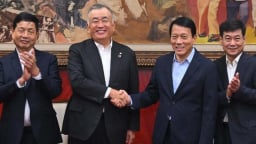
Vietnam police minister urges Yamato Holdings to study investment in Gia Binh airport
Vietnam’s Minister of Public Security Luong Tam Quang has called on Japan’s Yamato Holdings to assess investment opportunities in warehousing and cargo transport systems at Gia Binh International Airport, while exploring potential cooperation and operational models with Vietnamese partners once the facility becomes operational.
Infrastructure - Wed, July 8, 2026 | 3:09 pm GMT+7

Vietnam real estate M&A favors quality, clear legal status assets as FDI priorities evolve
Vietnam's real estate M&A market continued to attract foreign capital in the first half of 2026 despite persistent global economic uncertainties, but foreign investors are increasingly targeting assets with clear legal status, stable cash flow, and strong operational performance, with data centers emerging as a key growth segment.
Real Estate - Wed, July 8, 2026 | 1:38 pm GMT+7

Central Vietnam hub Danang plans to tokenize nearly $4 bln in infrastructure projects to attract global capital
The Vietnam International Financial Center, located in the central city of Danang (VIFC Danang), plans to tokenize nearly $4 billion worth of infrastructure projects as part of a strategy to attract more global capital.
Economy - Wed, July 8, 2026 | 12:17 pm GMT+7
Computers, smartphones edge higher in price as AI memory boom tests Vietnam's ICT firms
Rising memory chip prices driven by artificial intelligence are spreading from semiconductor manufacturers to consumer electronics brands such as Apple, Dell and ASUS, pushing up the prices of computers and smartphones.
Companies - Wed, July 8, 2026 | 8:00 am GMT+7
LG Innotek to build $1 bln semiconductor substrate plant in northern Vietnam
South Korea's LG Innotek will spend $1 billion to build a semiconductor package substrate manufacturing plant in Hai Phong city, with mass production scheduled to begin in the third quarter of 2028, according to local authorities.
Industries - Tue, July 7, 2026 | 11:13 pm GMT+7