


World’s top EV seller BYD considers Vietnam a unique, high-potential market: exec
With presence established in 88 countries and notable achievements in ASEAN, BYD sees a "golden opportunity" to develop in the Vietnamese market, says Vo Minh Luc, CEO of BYD Vietnam.
In the first half of 2024, BYD sold over 1.6 million new energy vehicles globally. Last year, the company sold 3.02 million vehicles, securing the top spot worldwide.
BYD officially launched its electric vehicles in Vietnam on July 18 this year. The company aims to build a comprehensive electric vehicle ecosystem in what it views as a crucial market, Luc said.
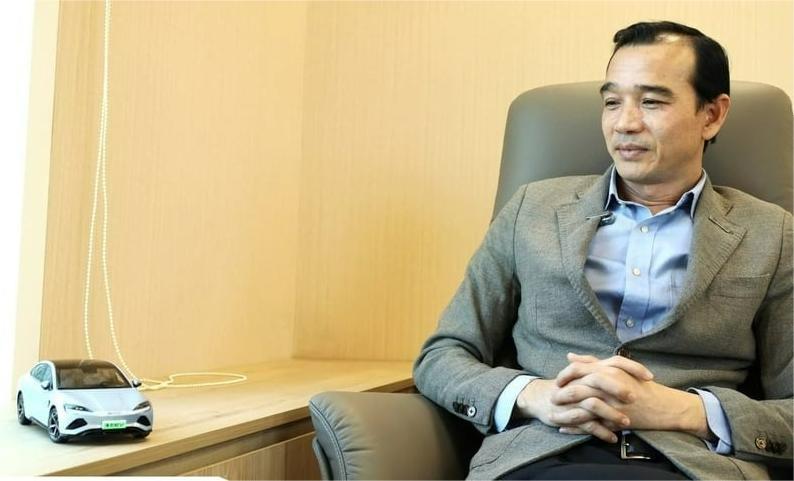
Vo Minh Luc, CEO of BYD Vietnam. Photo by The Investor/Minh Thong.
BYD was founded in 1995 in China as a company that produces batteries for electronic devices and vehicles such as Nokia and Motorola phones. But by 2022 you were exclusively producing electric cars. How did the switch happen?
BYD started as a supplier of about 50% of the world's battery output for leading phone companies Nokia and Motorola in the 2000s. Recognizing the potential of new energy vehicles and leveraging our battery production strengths, BYD shifted its focus. The turning point came in 2004, exactly 20 years ago, when BYD introduced its four-wheel motor control technology at a major Chinese auto show.
At the time, this idea seemed radical. Four years later, in 2008, BYD launched its first hybrid car (gasoline-electric hybrid), reflecting our long-term vision from 20 years ago that fossil fuel was finite and environmental damage severe, while renewable energy can be regenerated.
By 2024, BYD will have achieved its dream of producing the world’s first electric vehicle with separate four-wheel control technology, capable of rotating 360 degrees in place. After years of global expansion, BYD leads the world in both sales and new energy vehicle technology and we are continuously working to make the environment greener.
Please tell us about your entry into Vietnam and plans for this market.
It is true that we researched the market for over 10 years. Liu, general director of BYD Asia-Pacific, visited Hanoi and Ho Chi Minh City during that period for market research. At the time, the market was not yet suitable; vehicle scales were small, there was hesitation toward Chinese brands, and electric vehicles were not popular.
Another factor was that BYD had not yet developed significantly internationally. Now, with a presence in 88 countries and notable achievements in ASEAN, we see this as a golden opportunity to develop in the Vietnamese market. BYD considers Vietnam a key, high-potential market and the final ASEAN market for our expansion. We aim to create significant new value here.
BYD products in Vietnam are several hundred million VND (VND100 million = $4,000) more expensive compared to Thailand. Can you explain this price difference?
This is a common question from our dealers as well. Despite the similarities between Thailand and Vietnam, the differences are substantial. The most notable differences are in taxes and fees.
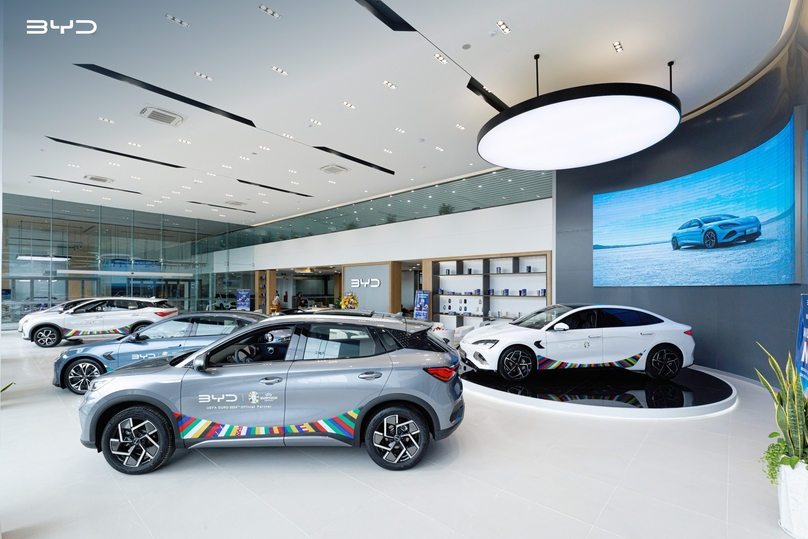
BYD’s electric cars. Photo courtesy of BYD Vietnam.
In Thailand, the import tax on BYD cars is 0% and VAT is 7%. In Vietnam, the import tax is 50% and the VAT is 10%. To illustrate, if a car manufactured in China costs $10,000, in Thailand it would cost about $10,700 after adding 7% VAT.
In Vietnam, the same car would cost about $16,500 due to the 50% import tax and 10% VAT. This explains why BYD cars are priced differently in Vietnam compared to Thailand and other markets.
However, I want to clarify that we strive to offer the most competitive prices at all times. At a dealer conference in Xi’an, China, Liu mentioned that despite BYD’s capabilities in technology, components, assembly and distribution, we face challenges in cost savings compared to companies that rely on external supply chains. But we are committed to minimizing costs for our customers.
Is BYD considering building an electric car factory in Vietnam to reduce import costs? What does Vietnam need to become a hub for electric car production and sustainable development?
Compared to other countries, investment incentives, especially in the automobile industry, are not as attractive in Vietnam. It's important to note that not all companies importing to Thailand receive 0% tax incentives. However, Thailand wants to develop its electric vehicle industry, so the government has introduced many incentive policies.
Similarly, Malaysia initially had high import taxes, but now offers the 0% incentive. If Vietnam had similar tax policies, the market would likely grow even faster.
As for BYD, we are researching and holding discussions with several localities to find optimal investment options. We plan to quickly move forward with the development of a car assembly plant in Vietnam.
It is said that the cautious mentality of the Vietnamese market poses a challenge, with many well-known Chinese companies either developing modestly or withdrawing from Vietnam after a short time. What is your opinion?
I’ve experienced this first-hand. When people learned I was working with BYD, even friends and relatives were hesitant. However, BYD overcame these barriers by offering test drives, and customers were very satisfied with the quality of the experience. We want customers to experience our vehicles before making a decision.
BYD is a global brand with a presence in many countries, all of which have welcomed us. We have approached the Vietnamese market with caution and care, knowing it is unique. When choosing dealers, we require experience and passion for electric vehicles and a commitment to bringing new value to the market.
After about two months in Vietnam, we’ve received many orders, indicating that customers recognize our value. We will continue to engage in activities that help customers better understand our brand.
BYD has mentioned it would not compete but collaborate with VinFast, a major domestic brand in Vietnam. Is this just a polite statement, or have there been discussions between the two sides?
BYD has never viewed any brand as a competitor. As I just said, the Vietnamese market is unique. When we entered other countries, there were almost no domestic electric vehicle brands. In Vietnam, however, there is a prominent brand like VinFast, which has significantly shaped the electric vehicle market and helped raise market awareness.
We acknowledge VinFast’s role and appreciate its contribution.
While we may face some level of competition entering the market alongside VinFast and other brands, our goal is to fulfill our mission and core values. Our presence aims to provide customers with more choices, which benefits the market overall.
To date, there have been no official discussions between VinFast and us. However, we are open to cooperating with any other investor or brand in the future.
What is BYD's approach to attracting investments and how does the company plan to address the need for charging stations? Will this affect your development in Vietnam?
In China, we initially invested in charging stations. However, as the electric vehicle market has grown, many other investors have joined in developing charging infrastructure.
BYD prefers to focus on its core strengths, such as products, batteries, and technology, rather than investing in charging stations. While investing in charging stations is less costly than manufacturing cars, it’s important for all brands to work together to develop the market, as seen in Thailand’s rapid development.
Developing charging stations will not hinder BYD’s progress in Vietnam. We provide cars with a 7 kW wall charger and free installation, as well as a portable charger for convenience. Depending on the model, a full charge will cost less than VND300,000 ($12) and offer a week of driving range.
Additionally, our dealer network is required to have fast and standard charging stations. Currently, we have 36 dealers across Vietnam, and we expect this number to grow to 50 by 2024. We also allow electric vehicles from other brands to use our charging stations, which helps us reach more Vietnamese users and brings economic benefits to our dealers.
We are also seeing interest from around 10 other businesses and investors planning to invest in BYD due to the rapid development of the electric vehicle market.
A BYD representative once mentioned building an electric vehicle ecosystem in Vietnam. How long will this take, and what is the company’s vision for the next 10 years in Vietnam?
The Vietnamese electric vehicle market is developing quickly, with many new brands entering the scene. Alongside VinFast, customers will soon see other brands like MG and Chery in addition to BYD.
Vietnamese customers are rapidly changing their perceptions regarding price, technology, after-sales service, and environmental concerns, which will further accelerate market growth.
BYD’s goal is to have 50 dealers in 2024 and 100 by 2026. We aim to build a comprehensive ecosystem, including electric vehicles and charging stations. While I can’t specify the exact timeline, with investor and community support, Vietnam’s electric vehicle market will transform significantly. We believe Vietnam will soon be a leading name in the electric vehicle sector.
We are committed to being a long-term partner. Our ambition drives us, and if we weren’t ambitious, we wouldn’t have reached our current position. BYD has made substantial progress in Vietnam, almost completing what’s needed to build a development platform in just a few months.
In the short term, we are focusing on expanding our dealer network. By October, we plan to launch three new car models in Vietnam and will continue to introduce more models in the near future. I often joke that our showroom space will likely be full next year due to the constant influx of new cars.
- Related News


- Read More

UOB Vietnam appoints Pham Hong Hai as deputy country CEO
Singapore's United Overseas Bank (Vietnam) Limited on Monday appointed Pham Hong Hai, former CEO of HSBC Vietnam and later Vietnamese bank OCB, as deputy country CEO, effective immediately.
Banking - Mon, June 15, 2026 | 2:26 pm GMT+7

Shinhan Bank Vietnam launches AI translation desk, strengthening customer experience, digital innovation
Shinhan Bank Vietnam has officially launched AI Translation Desk, an AI-powered interpretation solution designed to help foreign customers communicate more easily while using banking services in Vietnam.
Banking - Mon, June 15, 2026 | 12:03 pm GMT+7

FDI listings a missing piece in Vietnam's stock market development
As Vietnam's stock market moves closer to its long-awaited upgrade to secondary emerging market status and seeks to attract higher-quality capital, allowing more foreign-invested companies to list on domestic exchanges could broaden the pool of investable assets and support the next phase of capital market development.
Finance - Mon, June 15, 2026 | 11:14 am GMT+7

Chinese robot 'eyes' manufacturer builds 10-hectare factory in northern Vietnam
Orbbec Inc., a Chinese company specializing in 3D vision sensors and robotic hardware, is building an over-10-hectare manufacturing center in the northern province of Bac Ninh to serve international markets.
Industries - Mon, June 15, 2026 | 8:00 am GMT+7

Long Thanh airport project faces shortage of 2,000 workers
The Long Thanh International Airport project in the southern province of Dong Nai is still short nearly 2,000 workers compared to actual requirements during its final acceleration phase.
Infrastructure - Sun, June 14, 2026 | 6:08 pm GMT+7

Nghi Son Refinery and Petrochemical Complex turns profitable in Q1 on full-capacity operations
Operating at full capacity, the Nghi Son Refinery and Petrochemical Complex in Vietnam's central province of Thanh Hoa reported its first profit in Q1/2026, marking a significant turnaround after years of losses.
Economy - Sun, June 14, 2026 | 2:45 pm GMT+7

50 years of Gamuda Berhad and its urban development journey in Vietnam
Celebrating 50 years of establishment and growth, Gamuda Berhad – one of Malaysia’s leading infrastructure and urban development groups – has evolved from an infrastructure specialist into an integrated urban developer with a growing presence across Asia.
Real Estate - Sun, June 14, 2026 | 11:21 am GMT+7

Industrials, technology top Vietnamese sectors in M&A transaction volume
Vietnam’s M&A market recorded 24 transactions in May, with industrials, technology and healthcare sectors being the most active sectors in terms of transaction volume, writes Grant Thornton analysts.
Consulting - Sun, June 14, 2026 | 9:00 am GMT+7

Top Vietnamese garment maker Vinatex's H1 profit rises 14%, weak order visibility clouds outlook
Vietnam National Textile and Garment Group (UPCoM: VGT) reported consolidated profit growth of 14.4% in the first half of 2026, driven by a strong recovery in its yarn business, even as weakening global demand and uncertainty over U.S. trade policy cast a shadow over the sector’s outlook.
Companies - Sun, June 14, 2026 | 8:00 am GMT+7

Gamuda Land Vietnam recognized among Top 10 Enterprises Pioneering Green Transformation 2025-2026
Gamuda Land Vietnam has been recognized as one of the “Top 10 Enterprises Pioneering Green Transformation 2025-2026” at the 25th Golden Dragon Awards.
Companies - Sat, June 13, 2026 | 7:45 pm GMT+7

T&T pushes ahead with $97 mln industrial park project, eyes new urban area projects in northern Vietnam
Vietnamese conglomerate T&T Group is seeking to accelerate five projects in Bac Ninh while proposing two new developments in this northern province.
Infrastructure - Sat, June 13, 2026 | 7:09 pm GMT+7

VinFast guns for 300,000 EV deliveries in 2026, spins off manufacturing operations
VinFast, the EV arm of Vietnamese conglomerate Vingroup (HoSE: VIC) targets at least 300,000 electric vehicle deliveries globally this year, up 52% year-on-year, while pursuing a restructuring plan aimed at improving capital efficiency, according to a report by Vietcap Securities.
Companies - Sat, June 13, 2026 | 3:07 pm GMT+7

Vietnam economy resilience amid cost pressures, external strains: UOB
The VND has stabilized in recent weeks, trading in a range of VND26,291-26,372 per U.S. dollars in April-May, well within the State Bank of Vietnam’s ±5% band. In a report released on Friday, UOB analysts say on balance, they retain a gradual depreciation bias for the USD/VND, with updated forecasts of 26,500 in Q3/2026, 26,400 in Q4/2026, 26,300 in Q1/2027, and 26,100 in Q2/2027.
Consulting - Sat, June 13, 2026 | 11:49 am GMT+7

Vietnam Politburo issues resolution on FDI sector development
The Politburo, Vietnam's highest decision-making body, has issued a resolution that establishes a new mindset in developing the FDI sector.
Economy - Sat, June 13, 2026 | 8:17 am GMT+7

Japan’s Meiko breaks ground on $500 mln electronic circuit plant in northern Vietnam
Japanese electronics manufacturer Meiko Group on Friday broke ground on a $500 million electronic circuit plant in northern Vietnam, underscoring the country’s growing role in global technology supply chains and advanced manufacturing.
Investing - Fri, June 12, 2026 | 4:06 pm GMT+7

Vietnam's EVN discusses energy investment opportunities with Thailand's Gulf Energy
Vietnam Electricity (EVN) chairman Dang Hoang An met executives from Thailand's Gulf Energy in Hanoi on Wednesday to discuss the company's investment plans and the development of energy projects in Vietnam.
Energy - Fri, June 12, 2026 | 3:59 pm GMT+7